Google I/O 2026 and the Two-Speed Web
Google I/O 2026 was not just another model launch. It was Google putting a full agent stack in front of developers, Search users, Gemini users, and enterprise teams: Gemini 3.5 Flash for fast action, Antigravity for agent execution, managed agents in the Gemini API, and proactive assistants like Gemini Spark. The exciting part is obvious. The uncomfortable part is just as real: the web may now run at two speeds.
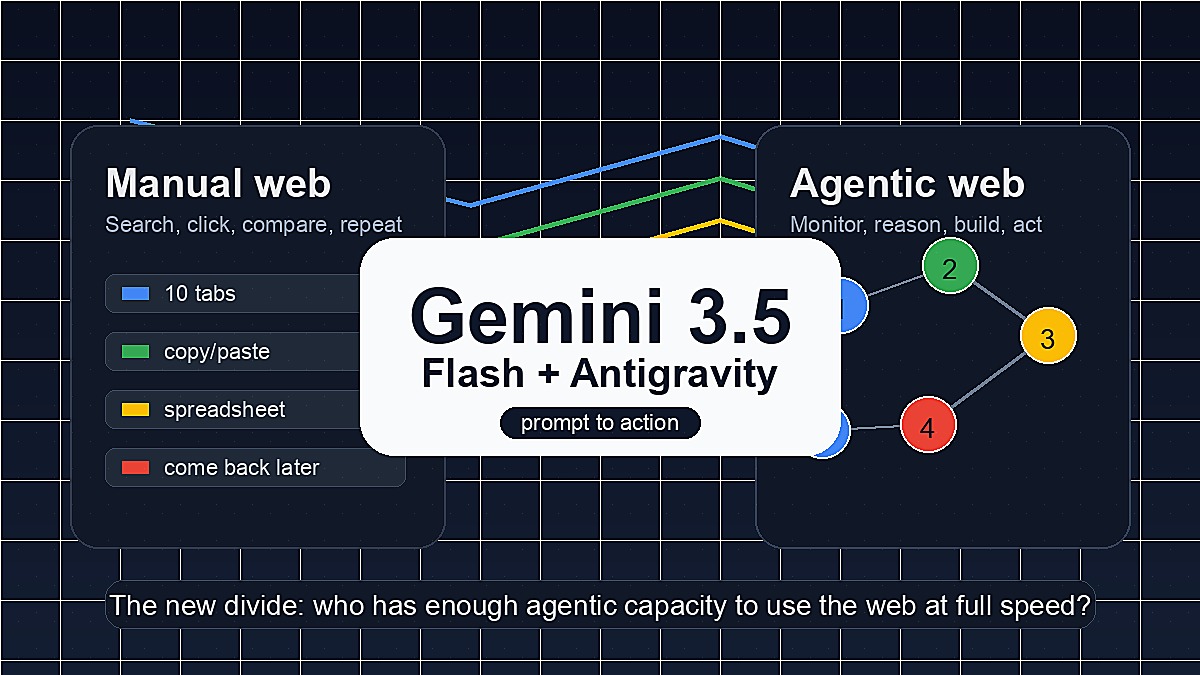
For years, the web was mostly a place you navigated yourself. You searched, clicked, compared, copied, pasted, and decided. Google is now describing a different interface: agents that monitor the web, build tools, reason across your apps, execute code, and keep working while you are away.
That shift can make people more capable. It can also make the gap between "I have AI capacity" and "I do not" much sharper than the old gap between fast and slow internet.
The short version
- Gemini 3.5 Flash: Google's new fast model family starter, positioned around agentic workflows, coding, and long-horizon tasks.
- Antigravity: Google's agent-first development platform and agent harness, now tied into desktop development, API-managed agents, AI Studio, and enterprise workflows.
- Managed agents: Developers can call an agent that reasons, uses tools, and executes code in an isolated Linux environment.
- Search agents: Google is moving from search results to ongoing information agents, custom dashboards, and agentic booking.
- The access issue: some of the most useful agentic capacity starts with paid AI Pro and Ultra tiers, including the new $100/month AI Ultra plan.
What Google actually announced
Google's I/O 2026 hub says the company is releasing Gemini Omni and Gemini 3.5, with Gemini 3.5 Flash as the first model in the new family. The key phrase is not "chatbot." It is action. Google describes 3.5 Flash as a model built for agentic workflows, available in the Gemini app, AI Mode in Search, Google Antigravity, the Gemini API, AI Studio, Android Studio, and enterprise products.
The developer announcement goes further. Antigravity 2.0, Managed Agents in the Gemini API, and native Android vibe coding in Google AI Studio all point in the same direction: Google wants agents to become a normal way to build, debug, search, monitor, and operate.
Managed Agents are the clearest signal. Google says a single API call can spin up an agent that reasons, uses tools, and runs code in an isolated Linux environment. That is not a nicer autocomplete. It is agent infrastructure as a product surface.
Why Antigravity matters more than the model name
A faster model matters because agents need to iterate. They plan, call tools, inspect results, recover from mistakes, and try again. If every step is slow or expensive, the agent feels like a demo. If the model is fast enough, a background workflow starts to feel like infrastructure.
Antigravity is the packaging around that shift. Google is making the harness, sandbox, skills, editor, terminal, browser, and API story part of the same system. Developers can define custom agents with instructions and skills. Enterprises can connect Antigravity to Google Cloud projects. Consumers will see the same pattern through Gemini Spark, Search agents, and AI-generated mini apps.
The real announcement is that agents are leaving the side panel. They are becoming an execution layer across the browser, the IDE, Search, Workspace, and cloud APIs.
The two-speed web
Here is the tension: the same web will not feel the same to everyone. One person will search manually, open ten tabs, compare options, write a spreadsheet, and come back tomorrow. Another person will tell an agent the outcome they want, then let it monitor, summarize, build a dashboard, draft the reply, and nudge them when the moment is right.
Google is already explicit about some sequencing. Search information agents are launching first for Google AI Pro and Ultra subscribers. Custom Search experiences powered by Antigravity are also starting first for Pro and Ultra subscribers in the U.S. Gemini Spark is planned for AI Ultra subscribers in the U.S. The new AI Ultra plan starts at $100/month, while the public Gemini subscription page still lists AI Pro at $19.99/month in the U.S.
That is the new divide: not "who has the internet" but "who has enough agentic capacity, quota, context, integrations, and skill to turn the internet into delegated labor."
What this means for marketers and operators
Search becomes an operating surface
If Search can build custom dashboards, run information agents, and trigger booking workflows, then SEO is no longer only about ranking a page. Your prices, availability, offers, product facts, documentation, and trust signals need to be machine-readable and current enough for agents to use.
Agent reliability becomes a business dependency
Teams will build campaign QA, reporting, creative review, sales research, and customer workflows on top of AI platforms. When those platforms slow down, hit usage caps, or ship regressions, the failure may look like a broken internal process unless someone is watching the upstream dependency.
The best operators will document work for agents
The gap will not only be money. It will be workflow literacy. Teams with clear source-of-truth docs, structured data, clean permissions, test accounts, and reusable instructions will get more leverage from agents than teams with scattered context and tribal knowledge.
A fair read: opportunity and inequality at the same time
It would be too easy to make this only dystopian. Agents can genuinely lower the barrier to building. A small business owner who cannot afford an agency may soon build a usable dashboard, automate research, or ship a simple Android app from a prompt. A student may get a tutor that actually follows through. A solo operator may compete with teams that used to have more headcount.
But access will still matter. Higher limits, faster models, deeper integrations, persistent environments, and agent priority are not cosmetic upgrades. They change how much work you can push through the system. If those capabilities sit mostly behind paid tiers, the web becomes more productive for people who can pay and more manual for people who cannot.
How to prepare without overreacting
- 1 Make your public information agent-friendly. Keep product data, pricing, availability, policies, and documentation accurate, structured, and easy to cite.
- 2 Write internal workflows like reusable instructions. If a human has to explain a process from memory, an agent will struggle too.
- 3 Measure where AI enters the funnel. Watch assisted conversions, AI referral patterns, branded search changes, and whether agents are compressing comparison journeys.
- 4 Monitor critical AI and ad platforms. If agents are part of launch, reporting, or campaign QA, their status belongs in the same operational view as Google Ads, Meta, Shopify, Slack, and Teams.
- 5 Set rules for agent autonomy. Decide which actions agents can take alone, which require approval, and which should stay manual.
Sources
- Google I/O 2026 announcement hub
- Gemini 3.5: frontier intelligence with action
- I/O 2026 developer highlights: Antigravity, Gemini API, AI Studio
- Introducing Managed Agents in the Gemini API
- Google Search I/O 2026 updates
- Gemini app agentic updates and Gemini Spark
- Google AI subscription updates from I/O 2026
- Gemini subscription plan page
Monitor the platforms behind agentic work
As AI moves from chat to execution, outages and degraded platforms become workflow risk. AdStatus monitors ad platforms and optional AI platform status feeds so teams see incidents before they waste budget or lose hours debugging the wrong thing.