Google Ads is adopting Meta's playbook: your target, not your budget, is now the real control
On August 17, Google is changing how Smart Bidding behaves on budget-limited campaigns. It is not a price increase in the literal sense. It is more structural: Google is moving the active constraint from a hidden budget effect toward the target you entered.
The short version
- Google date: the change starts August 17, 2026.
- Affected campaigns: limited-by-budget campaigns using target CPA or target ROAS, including Search, Shopping, Performance Max, Demand Gen, and Travel.
- Core principle: budgets control spend; targets control efficiency.
- Main risk: a stale target that was harmless in July can become an active bidding instruction in August.
- Action: use the Bid Target Adjustment Tool or your own lookback to align targets with recent performance before the switch.
How bidding worked until now
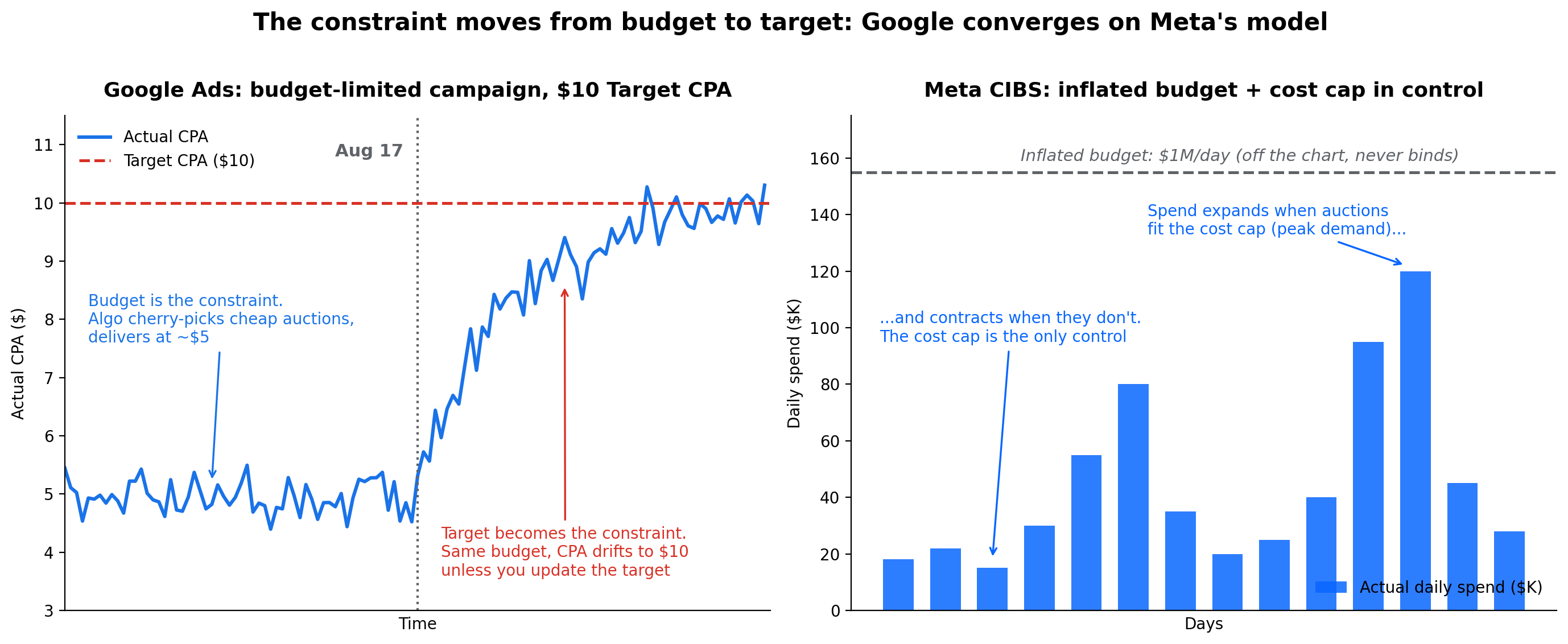
Take a campaign with a target CPA of $10 that is limited by budget. In theory, Smart Bidding should deliver conversions around $10. In practice, something better often happened: because the campaign ran out of budget before the target fully came into play, the algorithm could afford to be picky.
It skipped the expensive auctions and entered the safest ones. Many advertisers ended up with an actual CPA of $5, $6, or $7 against a $10 target.
The budget was the real constraint. The target was still there, but for many budget-limited campaigns it behaved more like a loose ceiling than the active economic instruction.
What changes on August 17
Google's help documentation says budget-limited campaigns using target-based bidding will perform more consistently toward the bid target after August 17. Google's example is direct: if the target CPA is $10 and recent actual CPA is $5, the campaign may deliver closer to a $10 actual CPA after the update unless you change the target.
Search Engine Journal's coverage of the advertiser reaction adds useful context: Google has clarified that budgets will not automatically increase, targets will not automatically change, and advertisers who want to keep today's stronger performance may need to update their targets before rollout.
Mechanically, this means the system can enter auctions it used to skip. Same daily budget, higher average cost per conversion, fewer conversions - unless the target is adjusted to reflect the efficiency you actually want.
The $10 target / $5 actual CPA example
Imagine a campaign spending $1,000 per day.
This is not a promise that every affected account will cut conversion volume in half. It is the direction of the constraint change. If the target says the business is willing to pay $10, and the system starts obeying $10 more closely, the same fixed budget can buy fewer conversions than it did at $5.
The Meta parallel: budgets that do not bind
This is where the update stops looking like an isolated Google decision and starts looking like a broader platform model.
On Meta, sophisticated advertisers have long used cost-per-result goals with intentionally inflated budgets, often called CIBS. The setup can look absurd at first: a daily campaign budget of $100,000, $500,000, or even $1,000,000 for a campaign that should realistically spend only a fraction of that.
The point is not to spend the full budget. The point is to make the budget irrelevant. With budget no longer binding, the cost target becomes the real control. Meta can spend when it believes it can find conversions at or below the target, and it can hold back when it cannot.
Google is enforcing a similar philosophy: budgets cap spend, targets control efficiency, and the two should not do each other's jobs.
The important difference
On Meta, advertisers usually opt into this model deliberately, with cost targets calibrated against current acquisition costs. On Google, the new behavior is being applied to affected campaigns on August 17, including campaigns whose targets were set months or years ago and then ignored because performance was overdelivering.
That is the real risk. A $10 target that was harmlessly stale in July becomes an active instruction in August.
Two honest readings of the change
Google's case: predictable scaling
Performance in budget-limited campaigns can fluctuate when budgets change. If Smart Bidding follows the stated target more consistently, advertisers can raise budgets with more confidence that the campaign will scale near the target they entered. That is a real benefit when targets are actively managed.
The skeptic's case: reclaimed efficiency
Campaigns that beat their targets were getting extra efficiency. If a campaign has been converting at $5 against a $10 target, nothing about the business changed, but the campaign may start moving toward the higher number. The correction is on the advertiser.
The question that decides which reading applies
Does your target reflect what you actually want to pay, or is it a number you stopped looking at because the campaign kept beating it?
What to do before August 17
- 1 Pull every campaign that was limited by budget in the last 12 months. Focus first on target CPA and target ROAS strategies.
- 2 Compare stated target with recent actual performance. Use 30 to 60 days where possible, not a lucky seven-day window.
- 3 Lower target CPA if actual CPA is materially better and you want to keep that performance. For target ROAS, the equivalent is raising the target if actual ROAS is materially stronger.
- 4 Use Google's Bid Target Adjustment Tool, but sanity-check the window. Conversion delay, seasonality, and lead quality still matter.
- 5 Avoid changing targets and budgets at the same time. If you move both levers together, you will not know which one changed performance.
- 6 Watch Performance Max and Demand Gen channel mix. Google says multi-channel campaigns may shift how traffic is distributed across channels.
The broader lesson
Modern ad platforms increasingly treat the target as the contract. The budget is the spending ceiling. The target is the economic instruction.
Set it like you mean it. Keep it current. Do not let a stale number become the thing the algorithm is finally told to obey.
There is also a strategic footnote. A platform can change a core delivery behavior with a few weeks of notice, and the adaptation work lands on advertisers. Whatever you think of this update, concentration risk is real. Channel diversification is not only a growth strategy. It is insurance against the day one platform policy rewrites your unit economics.
Sources
- Google Ads Help - Changes to target based bid strategies
- Search Engine Journal - Google clarifies Smart Bidding update after advertiser concerns
- Zac van Manen - The comprehensive guide to cost caps on Meta Ads
Monitor the platform layer around your campaigns
Bidding rules, status incidents, and platform changes all affect performance interpretation. AdStatus watches Google Ads and other platform status feeds so operators can separate account problems from upstream platform problems faster.